One important aspect of Organic and sustainable farming in either large or small scale is crop rotation or the movement of crops year to year to maintain favorable conditions. According to the text that we used in Dr. Bryans Organic Agriculture class, "Organic Agriculture: A Global Perspective" there is a given list of benifits gained by crop rotations which includes improvement of soil fertility and amount of organic matter, control of pests and weeds, and a supply of animal feed and nitrogen symbiotic species to reduce non organic inputs. Not allowing a crop to be grown in the same area of soil for more than two years prevents the accumulation of semi-mobile pests and reduces the primary or secondary innoculum of pathogens. Management of time between various tasks such as weeding and picking off insects may also increase small farm production by spending more time in each plot rather than focusing on one area while others are overgrown. The use of legumes, weather forage or grain, allow a build up of nitrogen in the soil which can then be depleated following years by more demanding crops. This is an alternative to the conventional application of artificial fertilizers to replace what is taken out by each crop that is grown subsequently year after year in a mono-crop system. The addition of cover crops and green manures also give the availabilty of mulches and animal feed on the farm rather than needing outside inputs. The use of specific crops such as clover may also prevent the build up of disease and fungal pathogens when rotated with susceptiable crops. Undersowing, or growing a smaller crop in the same area as another may reduce the amount of weeds while still providing competition for light and root growth. The annual movement of crops may as well reduce the need for rotovation and soil aeration as left over plant materials and organic matter will maintain a positive top soil condition.
Within the raised beds that are being constructed now, Frances would like to grow mostly cash crops for food rotated with different legumes and grass crops for healthy nutrient and disease management. If the lowest bed starts the rotation with a mix of legumes, likely beans or peas, they can be succeeded in the next plot by tomatoes and peppers which are more nutrient demanding crops. The other two beds can be sown with grain or oats and a root crop such as beets of carrots. Within the divisions of the beds we would like to rotate undersown crops, or crops that can be grown at the same time as the main crop to prevent weeds or to provide a cover crop on its own. The mixture of different crops which are able to be grown together allows root competition with each other rather than with unwanted weeds. These crops could include sunflowers, clover-grass mixtures, lettuce and select varieties of herbs. Arranging the placement of crops between the beds according to common heights would also be benificial to provide competition for light, often icreasing yields. Each year these plots will be amended with manure or compost as well as green manures grown elsewhere and shreeded plant materials as a mulch. If the family is able to raise poultry for eggs, a mobile fence can be constructed to allow the birds to litter a plot when it contains grass or cover crops allowing a build up of nitrogen every few years.
In another area of the property, we may be able to construct additional beds that can be arranged to grow green manures or grain crops that will be included in the rotation, but may not be used for main food crops. The grow season is short in the area and production of maize or demanding wheat crops may not be useful for yearly yeilds or food production, but would help maintain nutrients and soil structure in rotation with annual crops. Inclusion of the grass and clover mixture would be vital to help maintain fungal pathogens and semi mobile disease. The area in which Feargal plans to raise young deer can be planted with a mixture of green manures such as oats, buckwheat, vetch, and other grains that will also be used as feed for the herd.
For the field that will be used for potatoe production, it would be benificial to divide the area into ateast four plots that can be rotated yearly or biannually. Potatoes, clover-grass mix, beans, and oats would be four suitable crops to use in this rotation. Potatoes would be sown after the clover-gras mixture has been grown followed by oats or another grain that may be used for animal feed and then the beans. This rotation would hold even beter nutrient management if a winter crop such as wheat barley or rye were grown on a fifth plot between the oats and beans as a green manure or cover crop.
Other natural crops are raised surrounding these areas such as orchard and ornamental trees or different herbaceous species used as hedges. Natural ferns and grasses grow prevelently where the soil is undisturbed for a period of time which shows the condition of the topsoil to be able to hold its fertility and good structure. Most of the soils are a clay and silt mixture often having sand added for aeration. The Ph is commonly good for crop production, not needing lime or acidic substances added. Weeds are prevelent in any cultivated area and need to be cut back as often as possible to prevent loss of nutrients. Any weed that is allowed to grow without notice would need to be cut before it reaches a seed producing stage that would then create an outbreak of the weed the following year. The yearly rotations of the various crops will keep any semi-mobile pests or nemotodes from building up in the soil and preventing sustainable yields. Although a plan will be designed for the plots we are building at Knockanode, a full rotation may not be put into place until the following year with the use of pre-crops to increase soil conditions, allowing time for proper rotovation and sowing any winter crops later this season. Now we are mainly preparing beds and filling them with topsoil from higher up on the hillside to be used for a small amount of crops this grow season.
Showing posts with label Planning. Show all posts
Showing posts with label Planning. Show all posts
Friday, February 17, 2012

Tuesday, February 7, 2012
Day Two at Knockanode


Once back to Knockanode, i spent the remaining hours of light walking through the gardens, learning the property and taking a hike through the beatiful forest surrounding them. Out in the forest I came upon an area of thick rows of trees, some areas so full of evergreens that one would not be able to see or move through them. My host tells me this is because of an agreement between Irish Farmers and the Brittish government to cover thier open fields with specified spicies of hardwood for undisclosed reasons in return for the equivelent of what they could make off the fields growing local crops for buisness. This agreement was believed to contiue for a near fourty years once the farmers signed and agreed, destroying thier fields, but without notice the payments stopped within a decade and the propety owners went broke. The land that has experienced this occurence is now unusable as agricultural land, with most of the soil cosidered too acidic from thick carpets of pine needles, and the amount of work required to clear just one acre of the dense hardwoods. (seems like governmental abuse and conspiracy against small farmers in my opinion.)
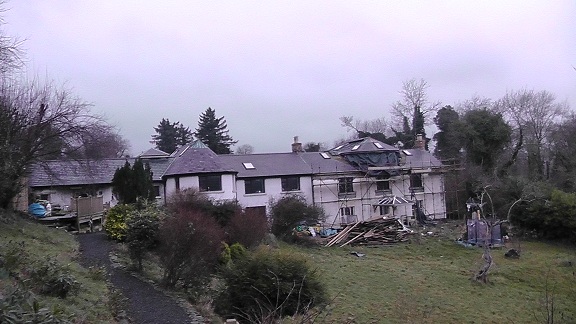
That evening, after a few laid back hours at the pub enjoying a liverpool football match, I joined my host, Feargal to see the parts of the house he was repairing and remodeling after a destructive snow storm last winter. We found ourselves discussing politics and current events between Europe, Ireland, and The United States for several hoiurs until half past three in the morning. At one point in the night, we walked into the forest close to the house in the moonlight for him to show me what is known as a fairy village, also known as nature spirits. In this circle, seven houses will be built by seven individuals to scale of a small creature from seven different types of wood gathered from seven different forests complete with windows, doors, furniture and water proofed walls and roof. Once the village is complete, and the spirit of the circle becomes alive, the nature spirits of the forest with take notice, and join together to live and celebrate starting on the Day of The Dead (Halloween) at midnight when one that is at peace and spiritually balanced will be able to sit at the ceneter a watch as the creatures dance and sing through the night, and then visable to the viewer as they live in these houses. A visitor to the house this afternoon, who is considered spiritually advanced, took a look at the progress of this fairy village, and claimed that the propety was full of the creatures keeping watch over us, and when it is complete, they will surely be present. One house is completed at the time, and three more in progress, and if interested, I have been offered to contribute a house during my stay. The completed house had been build by a French Wwoofer the past year, and Feargal thinks more visitors from various cultures cintributing is the best way to aquire the uniqe qualities and balance a spiritual force would be attracted to.
This morning I woke up later than I would have liked after the late night, but Feargal slept in as well. I began to clear brush and weeds around five boxes that had been used in years past and leveled out rows of sod arranging the boxes in a more manageable and optimal positions for lighting and harvesting. I then spent the rest of the afternoon working in the small orchard, replacing young pear and apple trees that had been damaged by deer the year before when the fencing failed. I had to be cautious with my arrangements, noticing two cultivars, Golden Delicious and Fuji which will cross pollinate if grown too close. Darkness takes over close to six, and I was forced inside as the cold night air settled.
It was a good day of work, yet an earlier morning would make it better. Tomorrow I will start to break down a collection of shipping crates left over from hauls of stone, wood, and tiles used to repair the house to build raised beds from. A few days of laborous clearing and leveling of the ground folled by building and filling with topsoil that will be gathered out of the forest. Within another week and a half we would like to be ready to start sowing peas and lettuce along with starting several crops indoors to prepare for transplant at the end of the month. Although locals are worried of the cold weather and heavy snow in europe to come this direction and furthur delay the start of thier growing season.
Subscribe to:
Posts (Atom)